by Lontum Alvin
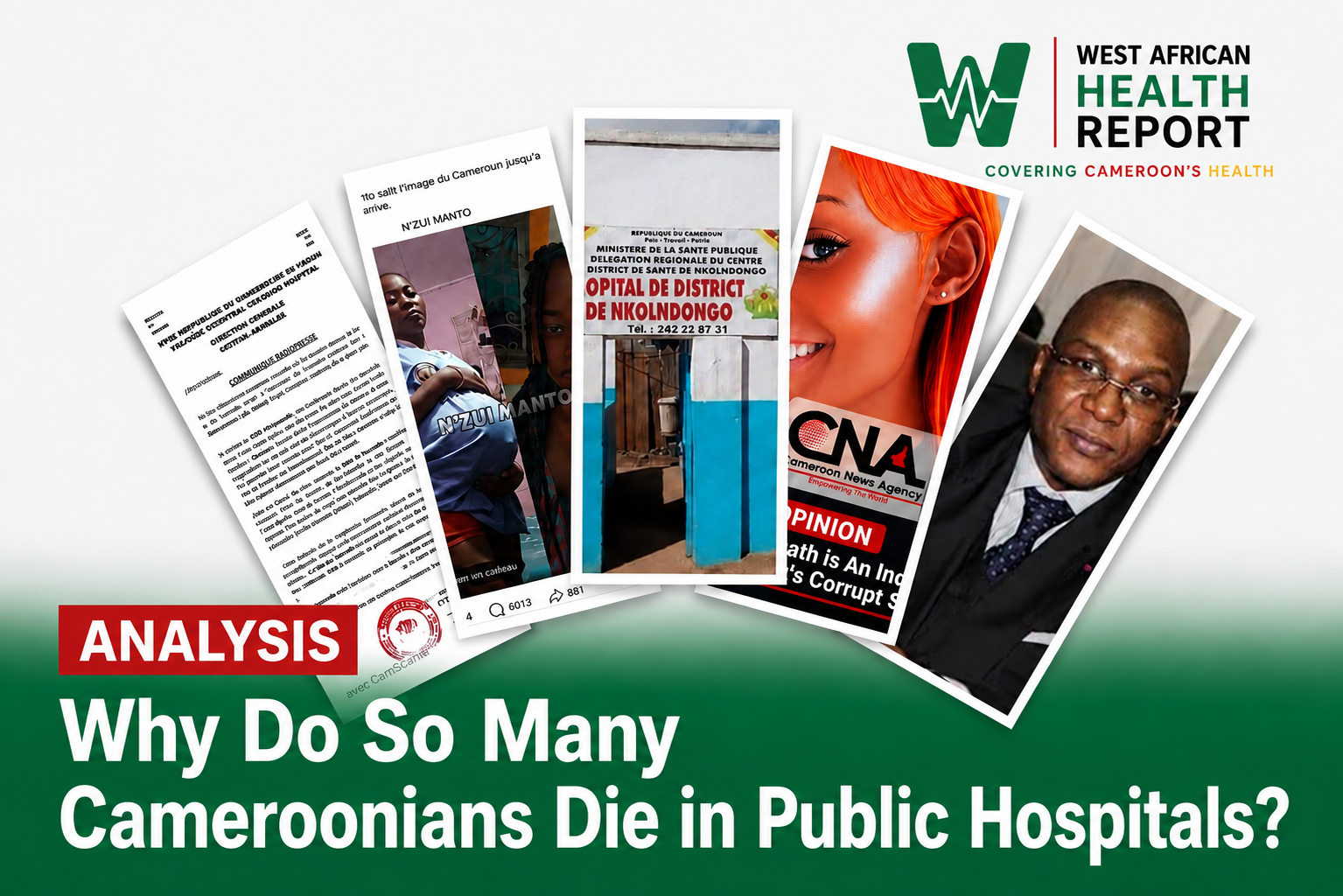
Cameroon’s health system is structured in a hierarchical manner from Referral Hospitals to health centers. The government through the ministry of Public Health , better known by its French-language abbreviation, MINSANTE, has made notable progress in health indicators overtime but the report card still leaves a lot to desired. This because we still have high mortality rates in Cameroon’s public hospitals – largely driven by systemic challenges that undermine the country’s potential. Recently, we have seen in the media, how Cameroonians have lost their lives from many preventable deaths. The case of Melissa Essomba who was turned away from the Nkolndongo District Hospital in Yaounde because she didn't have 8,000 CFA, comes to mind.
The health system may be complex in its way the dedication of healthcare workers is sometimes questionable – adding to the fact that an average Cameroonian does not have health insurance coverage. So how does this lead to so many Cameroonians dying in our public hospitals?
There are a number of factors that account for this:
1. Lack of Health Insurance and Financial Barriers
One of the most critical outcomes of a health system is life expectancy. In most countries where health insurance is treated as important issue, life expectancy is higher. The falling standards of living of most Cameroonians against rising costs exacerbates the situation for already poor Cameroonians. We recently read in the news about 22-year-old Melissa Essomba who died in Yaounde because the hospital demanded that she make an upfront payment of 8,000 CFA. A heavily pregnant Melissa didn't have the money and the hospital refused to attend to her. She ended up losing her life, after going home to fetch the money despite being in agonizing pain. This case is one many around the country where patients are denied care because of lack of money. Where there is a working health insurance scheme, lives are first preserved before financial calculations. With a minimum wage of about 60,000XAF, it is not easy to subscribe for health insurance, pay rents, take of feeding, settle utility bills, provide for children school fees and have money for health insurance and this explained by the fact that, Cameroon relies heavily on out-of-pocket payments, meaning patients must pay before receiving care, many families delay seeking treatment due to cost, arriving at hospitals only when conditions are advanced or critical and emergency situations are often worsened by “cash-before-care” practices, where treatment is delayed until payment is secured.
All of these mean that if an average salaried Cameroonian suddenly falls ill and they do not have money, they will receive care in health facility. This is not to blame the health facility, because it is failure at digitalizing the system. Some health facilities believe in helping restore health to patients in good faith but most of them, when they get well, it becomes the loss of the facility and there is no other way to track and make them pay. In my experience working with a health insurance scheme, many Cameroonians still lack knowledge on how it works. Let’s break it down.
A family registers her members and they are observed for three months and members can start benefit from health coverages after three months. The three months is to ensure that families are not registering people who are already sick so that they soak up the coffers. The reasoning about the health insurance is in simple terms that, you contribute and keep funds somewhere that if you get sick tomorrow, the hospital can save your life first before anything. An active member of the insurance scheme is entitled to a determined number of consultations, deliveries, in-patient and outpatient consultations. The subscriptions are usually valid for a year and will have to renewed in the following year. Some insurance schemes limit the illnesses they cover like terminal illnesses and things that drug refills because the contributions are sometimes less than 25000XAF for a family four. Families may consecutively contribute for up to three or four years without ever using a dime from that. As a community insurance scheme, it is believed that if you contribute this year and don’t consume any fraction of it, other sick community members will benefit from it. This means if you contribute and do not consume, the money used by others and you have to contribute for the same amount for the coming year. The advantage with subscribing in these is that the larger the family, the lesser they pay in individual contributions.
Each Cameroonian is advised to ask in the health facility around their neighborhood about a health insurance scheme that has partnered with it and get registered into a health insurance. This will make Cameroonians be attended in emergency situation with a sure of a membership card or if their name is on the database of the insurance scheme. With these members can benefit from cheap consultations fees and know what is wrong with their health. If this is not done, we will continue to witness late presentation of illnesses (malaria, infections, maternal complications), higher mortality rates from otherwise treatable conditions, and patients discharged prematurely due to inability to pay.
2. Poor Pay and Working Conditions for Medical Staff
The staff in our health facilities are not only demotivated by a low pay but an absence of the right work equipment. This lack makes them to suffer burnout from workload as there is a high patient-doctor-ratio. Healthcare workers in public hospitals also suffer from delayed wage payments. Some parts of the country are out of the electricity grid and even the availability of electrical equipment do not change health outcomes greatly. The consequence is that we have workers who care less about saving lives and some find better paying jobs abroad. Some medical doctors in Cameroon are okay serving as nurses to their peers out of the country because the pay is good. There is the growth of informal payments, where staff request unofficial fees to supplement income
This situation directly affects care quality, responsiveness, and patient trust.
Some of the health workers have in some places opened subsidiary pharmaceutical desks and refer patients to buy drugs from there while others have opened personal clinics where they spend a huge portion of their time rather than in hospitals where they are posted to work.
Insecurity like the north west and south west region has made some medical doctors to remain in the regional headquarters or delegations doing nothing while many nurses are doing what they never trained for. This goes to say some pay die because they were not attended to by qualified doctors.
3. Entrenched Systemic Corruption
Corruption remains a pervasive problem within parts of the healthcare system.
Examples include:
• Informal fees for services that should be free or subsidized
• Diversion and resale of hospital drugs
• Procurement corruption leading to substandard equipment or drug shortages
• Favoritism in patient care (those who pay more receive quicker attention)
Impact on mortality:
• Delays in treatment
• Lack of essential medicines
• Erosion of trust in public hospitals
• Inefficient allocation of already limited resources
4. Weak Training, Oversight, and Licensing Issues
We have a problem which is falling standards, these standards start from our primary, through secondary to tertiary education. The rigor in training is lost everyone can become a healthcare workers as survival instinct and not a desire to save lives. Those who struggle to get the best training do not stay in Cameroon due undesirable salaries as discussed above. Another issue is inconsistent training quality across institutions, then limited opportunities for continuing professional development, weak enforcement of licensing and regulation, and inadequate supervision in understaffed facilities
In some cases:
• Inexperienced personnel handle critical cases without proper support
• Diagnostic errors occur due to insufficient training or equipment
Result:
• Preventable medical errors
• Misdiagnosis or delayed diagnosis
• Poor management of complications
5. Broader System Constraints
Beyond the listed factors, several structural issues amplify the crisis:
a. Infrastructure Deficits
• Aging hospital facilities
• Frequent power and water outages
• Limited ICU and emergency care capacity
b. Drug Stockouts
• Essential medicines often unavailable
• Patients forced to buy drugs externally, causing delays
c. Rural–Urban Inequality
• Rural populations face severe shortages of doctors and facilities
• Long travel distances delay care
6. Interaction of Factors (Why the Problem Persists)
These issues do not act independently—they reinforce each other:
• Lack of insurance → delays in care → heavier workload on hospitals
• Low pay → corruption/informal fees → inequity in access
• Weak regulation → poor-quality care → increased complications
• Resource shortages → staff burnout → declining quality
This creates a cycle of systemic dysfunction that leads to avoidable deaths.
Conclusion
The high mortality rates in Cameroon’s public hospitals are not due to a single cause but rather a convergence of:
• Financial barriers to care
• Underpaid and overstretched health workers
• Corruption in resource allocation and service delivery
• Weak regulatory and training systems
Addressing these challenges requires comprehensive reform, including:
• Expansion of universal health coverage
• Improved salaries and working conditions for healthcare workers
• Anti-corruption enforcement
• Strengthened medical education and licensing systems
• Investment in healthcare infrastructure
Without tackling these root causes, improvements in patient outcomes will remain limited.
Strengths of the Cameroonian health system include a structured hierarchical network of facilities (from health centers to referral hospitals), government efforts to expand access, and notable progress in certain health indicators over time. The system provides relatively inexpensive or nominally free services in public facilities, supported by international partners and NGOs. There has been improvement in life expectancy (rising from around 53 years in 1990 to about 59-64 years recently), reductions in maternal mortality (from higher levels to around 258-406 per 100,000 live births in recent data), and under-5 mortality declines. High coverage of antenatal care (around 85% for some services) and skilled birth attendance in urban areas, along with training institutions and programs for health workers, represent positive foundations. Public-private partnerships, faith-based providers, and initiatives like performance-based financing have shown localized successes in improving service utilization.
Despite these strengths, high mortality rates in public hospitals remain a serious issue, driven by systemic challenges that undermine the system's potential. Many preventable deaths occur due to a combination of factors, including those you mentioned.
Lack of Insurance and High Out-of-Pocket Costs
Cameroon lacks widespread health insurance coverage. Only a small percentage of the population (around 1-6% in older data, with limited progress toward Universal Health Coverage) has meaningful coverage against illness. Most people rely on out-of-pocket payments, which account for a large share (around 70%) of health financing.
This leads to delays in seeking care, incomplete treatments, or families exhausting resources mid-treatment. In public hospitals, patients often face unexpected costs for drugs, supplies, or "informal" fees, contributing to higher mortality from treatable conditions like infections, hemorrhages, or complications in childbirth. Rural and low-income populations are hit hardest, exacerbating urban-rural disparities.
Poor Pay for Medical Staff
Salaries for health workers in the public sector are often low, unreliable, or delayed, leading to demotivation, absenteeism, brain drain to the private sector or abroad, and supplementary income-seeking behaviors. Heavy workloads, poor working conditions, and shortages of staff (Cameroon has far fewer doctors per capita than recommended in some metrics) compound this.
Underpaid and overstretched staff can result in slower response times, reduced quality of care, and burnout, directly impacting emergency and critical care outcomes in hospitals.
Entrenched Systemic Corruption
Corruption is a well-documented issue, with reports of bribes for services that should be free or subsidized, theft of medicines, favoritism, and informal payments. Patients frequently pay extra to receive attention, drugs, or priority.
This diverts resources, erodes trust, and creates barriers to care. It particularly affects the poorest, who may forgo treatment or receive substandard care, contributing to deaths from conditions like sepsis, malaria complications, or obstetric emergencies that could be managed with proper resources.
Poor Training, Lack of Licensing, and Related Quality Issues
While there are training institutions, challenges persist with uneven quality of education, insufficient continuing professional development, shortages of specialists, and gaps in rural staffing. Licensing and oversight may be inconsistent, leading to variations in competence. Combined with equipment shortages, drug stockouts, and inadequate infrastructure in many public facilities, this results in higher rates of complications and deaths (e.g., from neonatal sepsis, prematurity, birth asphyxia, postpartum hemorrhage).
Other contributing factors include late presentation of patients (due to access barriers or preference for traditional care), overburdened referral hospitals, and broader issues like conflict-affected regions disrupting services.
In summary, Cameroon's public hospitals save many lives daily, but structural weaknesses turn potentially survivable cases deadly. Addressing these requires stronger insurance schemes, better remuneration and accountability for staff, anti-corruption measures with transparency, and investments in training and infrastructure. Progress toward Universal Health Coverage, as outlined in national strategies, offers a pathway forward if backed by sustained political will and efficient resource use. Reforms like performance incentives and public-private partnerships have shown promise in pilots and could be scaled.
Alvin Lontum is a Health Economics Researcher with eBase Africa (Essential Basic Services) in Yaounde